Sacred Spaces and Study
During research travels in Italy, I visited several churches dedicated to the Divine Mother and other sacred sites. These visits provided rich inspiration for my experimental media projects, informing my work on the Divine Feminine, ritual, and sacred architecture. The videos below document the visual, spatial, and spiritual qualities of these sites, supporting the conceptual and aesthetic development of my immersive visual and media arts practice.
Chiesa Santa Maria Assunta - Civita (Calabria) S. ITALY
The church is dedicated to Santa Maria Assunta, which refers to the Assumption of Mary into heaven—a central figure representing the Divine Feminine in Christian tradition. Mary embodies nurturing, protection, and spiritual guidance, making her a living archetype of the Divine Mother in Western Christianity. The church’s devotional focus reflects centuries of cultural reverence toward these qualities, connecting it directly to themes of feminine divinity and sacred ritual.
Architectural Significance and Sacred Space:
Chiesa Santa Maria Assunta exemplifies traditional Italian ecclesiastical architecture, with features such as vaulted ceilings, sculpted altars, frescoes, and symbolic ornamentation. The building’s proportions, use of natural light, and spatial hierarchy create a meditative environment, guiding visitors through an experiential journey of contemplation and spiritual reflection. The architecture itself becomes a vessel for sacred energy, mirroring principles you explore in your media work: light, space, rhythm, and symbolic layering.
Chiesa San Francesco, Castrovillari, (Calabria) S. ITALY
Although dedicated to Saint Francis, the church embodies spiritual principles aligned with the Divine Feminine through its emphasis on contemplation, humility, and care for the sacred. Many Franciscan churches include Marian imagery or subtle devotional references to the Mother archetype, linking visitors to qualities of nurturing, protection, and spiritual guidance—hallmarks of the Divine Mother.
Architectural Significance and Sacred Space:
The church exemplifies Italian ecclesiastical architecture with features such as vaulted ceilings, arches, frescoes, and meditative spatial organization. Its design creates an immersive environment where light, proportion, and sacred symbolism invite contemplation, echoing the rhythms and flows of spiritual energy that you explore in your media work. The architecture itself functions as a vessel for sacred experience, highlighting how space can be used to evoke ritual and presence.
Chiesa di San Pietro, Frascineto, (Calabria) S. ITALY
While dedicated to St. Peter, the church’s spiritual and symbolic environment resonates with qualities of the Divine Mother—nurturing, protection, and the sacred cycles of life. The presence of Marian iconography, devotional motifs, and the contemplative atmosphere reflect a feminine, guiding energy, supporting inner reflection and connection to higher spiritual principles.
Architectural Significance and Sacred Space:
The church demonstrates traditional Italian ecclesiastical architecture, including arches, frescoes, and vaulted ceilings that create a sense of elevated space. Its design orchestrates light and shadow to enhance meditative and ritual experience, highlighting the interplay of sacred geometry and sensory perception—elements that parallel your work in immersive media arts.
This site-based research is informed by earlier embodied and visionary experiences that initiated this inquiry. This documentation represents a portion of my ongoing research into sacred architecture, ritual, and the Divine Feminine. The study of these sites is essential to understanding the symbolic and experiential dimensions that inform my media arts practice. Further exploration and documentation are continuing.
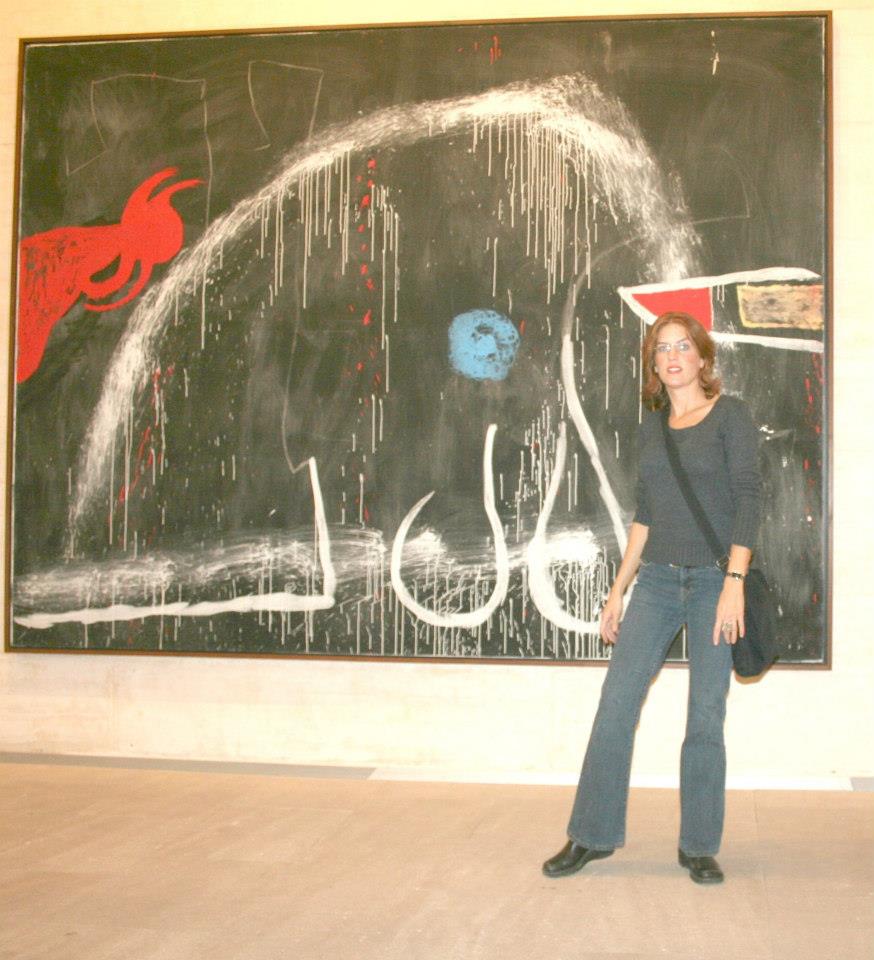
Joan Miro & The Goddess, Palma, Mallorca, SPAIN
Seeing Joan Miró’s work in person was essential to my understanding of the Goddess because it revealed something that cannot be transmitted through reproduction or explanation: the living intelligence behind the marks. Standing before his paintings, I sensed that Miró was not illustrating ideas but listening inwardly, allowing something ancient, playful, and cosmic to move through him — the same generative presence I experience as the Goddess. The scale, the breathing space of the canvases, the vibration of colour and line made it clear that his work arises from an internal dialogue with a force larger than the individual self, a force that creates through intuition rather than control. In that encounter, I recognised how the Goddess can express herself as joy, innocence, and freedom, not only as depth or gravity, and how the act of making can become a form of devotion without naming itself as sacred. Witnessing Miró’s work bodily and spatially helped me trust my own inner knowing — that the Great Mother moves through the artist as impulse, rhythm, and symbol, shaping a visual language that feels both timeless and alive.
Toguo & The Goddess, London UK
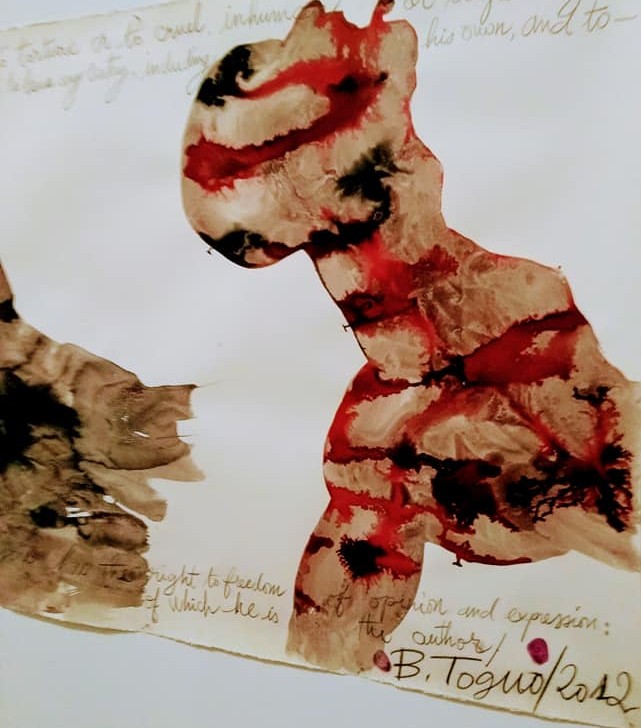
Toguo’s work often channels visceral, elemental energy — color, form, and gesture that feel lived, felt, and embodied rather than symbolic in a purely conceptual way. This is much like my own artistic engagement with the Great Mother as a living presence reflected through color and form, rather than just myth.
In my mind, Barthélémy Toguo’s work speaks to the Goddess not as an image but as a force: his saturated, unruly colours feel like elemental currents rising from the same deep source as the Great Mother herself, carrying birth, rage, grief, fertility, and endurance all at once. His figures and vessels do not narrate stories so much as hold states of being, as if they are bodies through which ancestral memory, suffering, and renewal move — much like the Goddess who is not separate from human life but pulses through it. The intensity of his palette feels ritualistic, almost alchemical, as though colour itself becomes invocation, echoing a pre-verbal, earth-bound knowing that predates doctrine or form. In this way, Toguo’s work inhabits the same inner terrain as my goddess work: a place where the body is sacred landscape, where beauty and brutality coexist, and where creation and destruction are inseparable movements of one vast maternal intelligence.
St. John's Church, West Ealing London UK
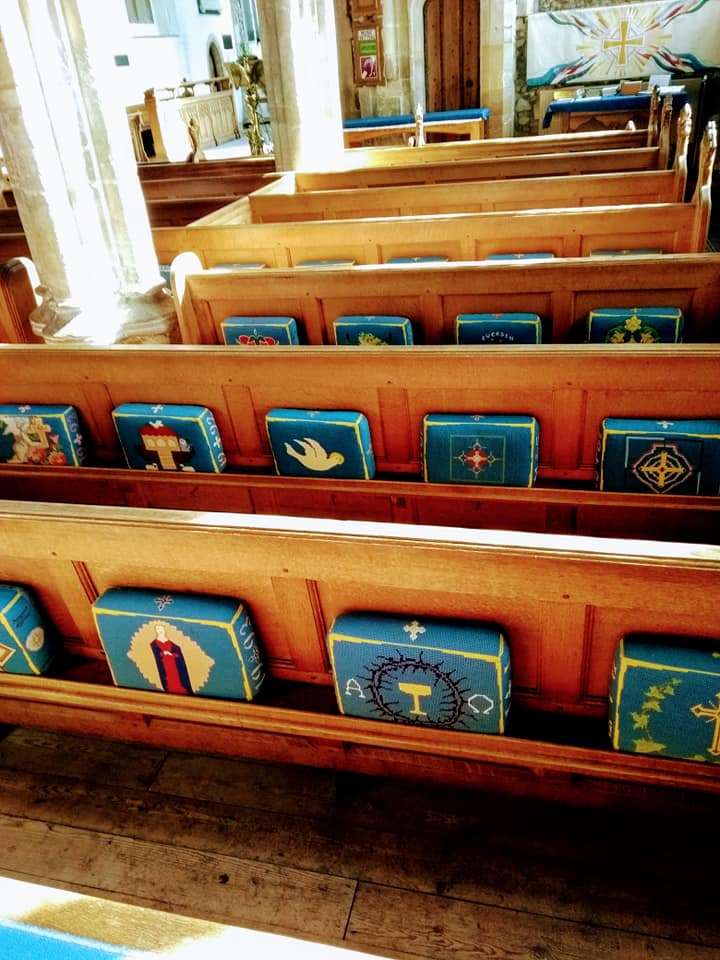
When I explored the churches in West Ealing, London, and stepped into St. John’s Church, I was struck by the abundance of motifs—symbols, repeated patterns, and vivid colors—that seemed to pulse with an energy I instantly recognized as the presence of the Goddess and and the details of her sacred circle. The stained glass, carved details, and decorative flourishes were not just ornamentation; they were visual incantations, echoing cycles of creation, protection, and communion. The repetition of forms felt like ritual in stone and light, a rhythmic embodiment of the sacred feminine that mirrored the continuous, generative cycles I work with in my own practice. Each symbol and color acted as a signpost, inviting me into a deeper awareness of the Goddess as both immanent and transcendent—alive in the body, the circle, and the shared space of devotion. Being surrounded by these patterns and colors allowed me to feel the sacred not intellectually but viscerally, giving me a renewed trust in the power of form, repetition, and hue to carry spiritual meaning. In that space, I recognized how motifs could act as vessels for energy and presence, which has deeply informed my own work by showing me that the Goddess can move through pattern and color as naturally as through ritual and intention, and that the circle itself is both a protective container and a living, breathing form of devotion.