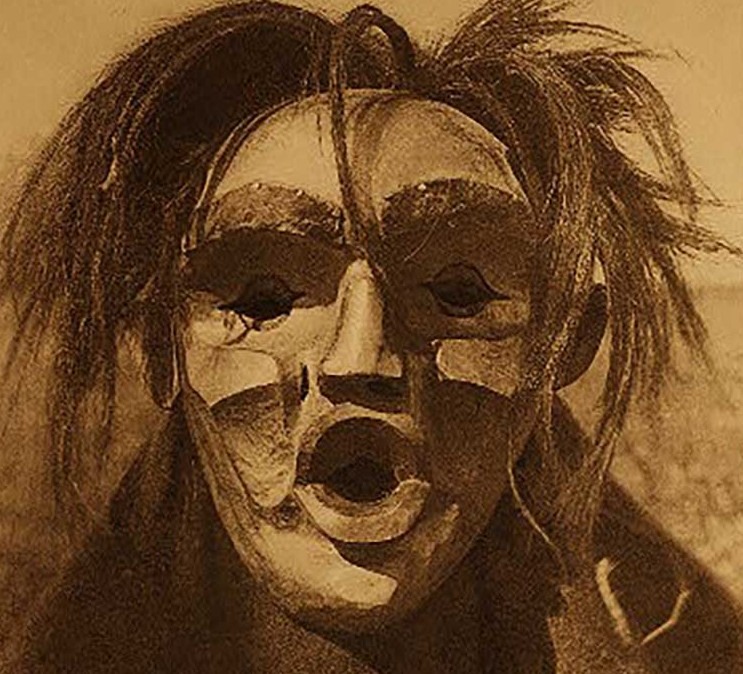
Dzunukwa belongs most strongly to the Kwakwaka’wakw nations of northern Vancouver Island and the mainland coast. In the earliest tellings, Dzunukwa is not a monster and not a villain. She is a wild woman of the forest, older than villages, older than houses, older than stored food. She lives where humans do not — beyond trails, beyond law, beyond comfort. She is immense, solitary, and powerful. Her hunger is constant, because she exists outside the systems of sharing and reciprocity that sustain human life. She calls out in the forest with a deep, echoing voice — not to terrify, but to draw attention. Her call marks the boundary between safety and danger.
Humans encounter Dzunukwa when they forget balance: when children wander too far, when people become careless, greedy, or disconnected from communal responsibility. She does not hunt villages. She encounters those who step outside protection. In the oldest stories, she takes children, placing them in a basket on her back — not to eat them immediately, but because she does not understand human kinship the way humans do. She is not cruel; she is unsocial. She exists before social order.
The children survive not by strength, but by cleverness, cooperation, and listening. They trick her — often by making her laugh, tiring her, or lulling her to sleep. When Dzunukwa sleeps, she becomes vulnerable. When Dzunukwa is overcome, she does not curse humans. She leaves behind wealth. From her house — hidden deep in the forest — come stored foods, coppers, valuables, the resources that later allow families to host feasts and potlatches. This wealth is not stolen; it is released when humans demonstrate intelligence, restraint, and social cohesion.
Dzunukwa herself does not die forever. She withdraws. She remains in the forest, still calling, still hungry, still present. She is not defeated — only negotiated with.